Commonly confused words: spade and shovel
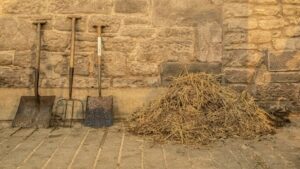
Shovels and a pitchfork
It’s simple. A shovel has a rectangular or square shape, with a broad, flat edge. It’s used to scoop up and move loose materials – like sand, soil, stones or even soiled bedding in stables. The fact that we use this tool to deal with large quantities has led to its use as a verb: when we shovel food into our mouths, we are putting in as much as we possibly can.
It is a secret not known to many writers that a spade is a different tool.
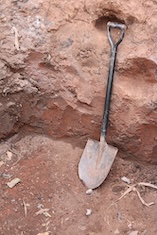
A spade
A spade is used for digging holes.Its front edge curves to a rounded tip, so that it can be more easily forced into hard ground. (The shape is exactly like the shape on the suit of cards called, surprisingly, ‘spades’.) While you can use a spade for shovelling dirt, it will take you longer than if you use a shovel.
Trent Dalton’s novel All Our Shimmering Skies features a gravedigger’s daughter who names her favourite shovel ‘Bert’. While the novel is wonderful in many ways, I’m pretty sure a gravedigger’s daughter wouldn’t have a shovel. She’d have a spade – much more useful in her line of work. If, on the other hand, she worked in a stable, she would definitely be using a shovel to muck out the horse boxes.
Melbourne Cup tips

2013 Melbourne Cup
It is, once again, that fabulous, magical time of year: Cup week. The only thing easy to say this year is that it is highly likely that the winner will be trained by either Joseph O’Brien or Ciaron Maher: between them, they have 12 of the 24 runners (I don’t think that’s a good thing). Anyway, I have crunched the numbers as best as I can, and here are my selections (in a surprising twist, I’m going with the favourites this year).
2 – Trustyourinstinct. One of the five (!) Joseph O’Brien runners. I have a huge amount of respect for this trainer, and this might just be the class horse of the field. It’s one of the few runners that has covered 3200 metres in a race, and, while I’m no fan of James Macdonald, he is in sizzling form. No wonder this horse is equal favourite.
3 – Knight’s Order. Two years ago I made a note beside this horse’s name that said ‘no form’ – and it’s exactly the same this year. Except that this time we know he can win. He has the fastest 3200-metre time of any horse in the field, but he is two years older and has 5 more kilos to carry. That might be too much for him, but I’m not dismissing him again.
12 – Hopewell Rock. In a field of many horses in their senior racing years, this 5-year-old is in the prime of his career. He has never run over the Cup trip, but he has at least won over 2800 metres. He has never raced in Australia either, but he has good form. So maybe . . .
16 – So You Are. Can this son of So You Think do what his dad didn’t do and win the Cup? I hope so. He may not have run beyond 2600 metres, but he is bred to do it. And he comes with picket-fence form, having won his last 4 starts. Sure, the Bendigo Cup is not usually considered a lead-up race, but winning form is good form. That’s all a horse can do. He will be over the odds because Rachel King is riding him. Sometimes, sexism has unexpected benefits.
20 – Point Of Law. The other equal favourite, and after that impressive Geelong Cup win, deservedly so. One of Ciaron Maher’s seven (!!) runners. Two big queries: did that hard front-running win take too much out of him? And can he keep going for the extra 600 metres of the Melbourne Cup trip? I’m crossing my fingers that he can.
23 – Zakouma. Yet another horse that has made it as far as 2800 metres, but never run further. He has the advantage of almost no weight, and a canny trainer in Graham Begg.
24 – Schokletz. Now her daddy (Shocking) did win, and while she is (yet another) who will be trying 3200 metres for the first time, she has an excellent record at 2500 metres at Flemington. Yes, it is a concern that Harry Coffey broke his collarbone on Derby Day, but is still planning to ride her (I’m more worried about him lasting the race).
That’s 7 horses. Put $1 each way on all of them for $14. A duet with all 7 will cost $20.50 for 50% (half) of the payout (which you will get if at least 2 of them run anywhere in the first three). Or box them all in a trifecta, where $21 will get 10% of the payout (currently estimated at anywhere between $365 and $16,192 – but I do have to have found all three placegetters in my 7).
If you have found this post interesting, you can find a full index to my other posts on the index page. To be notified when I post a new topic, follow me on Facebook! If you have any particular questions you’d like me to answer in future posts, just send me a message. I’m always interested to learn what people think, and how you came across this site, so please post a comment.
If you think you would be interested in either my complete grammar course or an individual customised online course (particularly suited for people who don’t live in Melbourne), just click your preferred option.
